
Malaysian football fans seek detailed insights into their national championship, its structure, and the fierce competition among clubs. The Malaysia Super League serves as the premier men’s football division, uniting 12 teams in an autumn–spring calendar that determines continental qualifiers and relegation spots. Since 2004, the league has evolved from regional tournaments into a centralised platform where Johor Darul Ta’zim claimed twelve consecutive titles, Selangor and Pahang renewed historic rivalries, and promoted sides like Kelantan Red Warrior challenged established giants. This comprehensive guide covers the Malaysia Super League in expert detail—season format, standings principles, A1 Semi-Pro League promotion, AFC Cup allocation, dominant dynasties, and the latest malaysia super league table intrigue—equipping every supporter and analyst with the knowledge to follow the competition responsibly.
History of the Malaysia Super League Since 2004
The Malaysia Super League replaced the semi-professional M-League structure in 2004, marking the transition to a fully professional national championship. Before 2004, regional state leagues operated independently; the Football Association of Malaysia unified them under a single pyramid to raise commercial appeal and attract international broadcast deals. The inaugural season featured eight clubs representing Malaysia’s most populous states—Selangor, Perak, Kedah, Pahang, Kelantan, Negeri Sembilan, Sabah, and Penang.
Between 2004 and 2012, titles rotated among Selangor, Kedah, and Kelantan, each winning two or three championships. Selangor’s 2009 triumph ended a drought dating to the 1990s, while Kelantan’s back-to-back wins in 2011–2012 reinforced the northern state’s resurgence. The league adopted FIFA-standard licensing criteria: clubs had to demonstrate financial solvency, youth academies, and stadium safety certifications to retain their spot.
From 2013 onwards, Johor Darul Ta’zim reshaped the competitive landscape. Backed by the Johor royal family’s investment, JDT recruited continental stars, built a 40,000-seat stadium in Iskandar Puteri, and established youth pathways modelled on European academies. The club secured its first title in 2014 and has not relinquished it since, setting a Southeast Asian record for consecutive domestic championships.
Autumn–Spring Season Format and 12 Participating Clubs
The Malaysia Super League operates on an autumn–spring calendar, kicking off in August and concluding in May. This schedule aligns with the regional monsoon pattern, avoiding heavy rainfall between November and February. Each season comprises 22 matchdays: twelve clubs play home and away in a double round-robin, totalling 132 fixtures. Final standings after matchday 22 determine champions, continental qualifiers, and the relegated side.
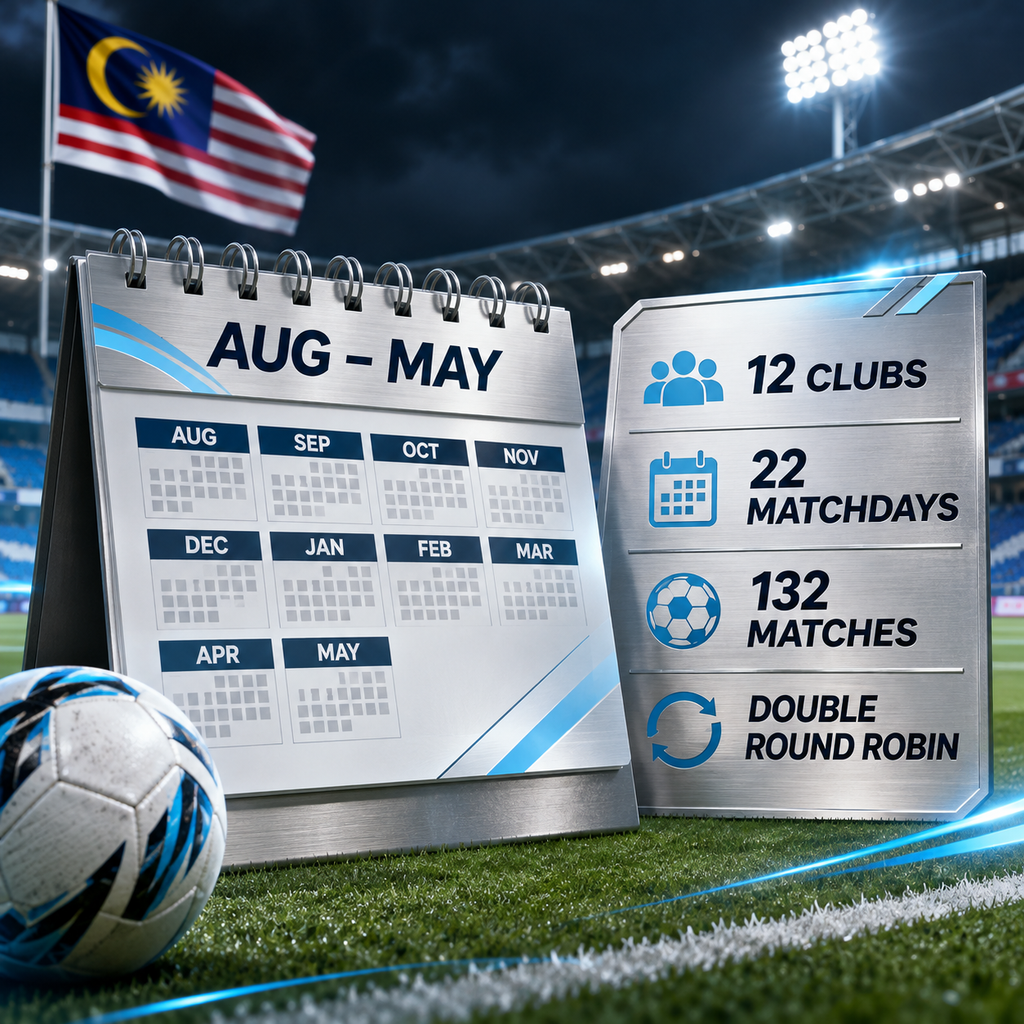
For the current campaign, eleven teams retained their places from the previous season, while Kelantan Red Warrior earned promotion from the A1 Semi-Pro League. Kelantan The Real Warriors and PDRM exited after failing to secure national licensing, which mandates proof of corporate governance, stadium lease agreements, and youth-development programmes. Immigration FC rebranded to Star City, reflecting new ownership.
Matchdays typically occur on Saturdays and Tuesdays, with kickoff times staggered between 20:45 and 21:00 local time to maximise television viewership. Friday evening slots cater to states observing a Sunday–Thursday working week. Broadcasters hold exclusive rights for domestic and regional markets, streaming every match live on subscription platforms. Clubs retain a share of broadcast revenue, distributed according to league position and audience ratings.
Principles of Forming the Malaysian Championship Standings
The malaysia super league table ranks clubs by total points, calculated under the standard three-points-for-a-win system. Teams level on points are separated first by goal difference, then by goals scored, head-to-head record, and finally a play-off if the title, continental spot, or relegation hinges on the tie. This hierarchy mirrors FIFA guidelines, ensuring transparency.
Goal difference plays a decisive role when clubs finish within one or two points of each other. For example, in the 2018 season, Perak and Pahang both accumulated 42 points, but Perak claimed second place with a +18 differential against Pahang’s +14, securing the AFC Cup berth. Clubs monitor live scores on final matchdays, adjusting tactics—defensive teams may prioritise clean sheets, while attacking sides chase additional goals.
Head-to-head records apply only when two teams remain inseparable by points, goal difference, and goals scored. If three or more clubs tie, the league reverts to overall goal difference rather than mini-league calculations. The Football Association of Malaysia publishes updated standings within two hours of each matchday’s final whistle, accessible via official apps and partner websites.
| Criterion | Order | Application |
|---|---|---|
| Total Points | 1st | Three per win, one per draw, zero per loss |
| Goal Difference | 2nd | Goals scored minus goals conceded |
| Goals Scored | 3rd | Rewards attacking play when difference is equal |
| Head-to-Head | 4th | Applied to two-club ties only |
| Play-Off | 5th | Neutral venue, single match, extra time and penalties |
Division Rotation and the A1 Semi-Pro League
Promotion and relegation link the Malaysia Super League with the A1 Semi-Pro League, the second tier comprising regional clubs that meet stricter licensing standards. Each season, the bottom-placed Super League side drops automatically, while the A1 champion ascends. No play-off exists between the second-bottom Super League club and the A1 runner-up.
The A1 Semi-Pro League accommodates clubs unable to satisfy top-flight financial thresholds—minimum annual budgets, independent audits, and stadium capacities above 10,000. Teams relegated from the Super League retain professional contracts and infrastructure, often bouncing back within one or two seasons. A1 champions must upgrade facilities and submit three-year business plans before receiving final approval.
Relegation carries significant financial consequences: broadcast-revenue shares shrink by approximately 60 per cent, and commercial partners renegotiate contracts downward. The Football Association of Malaysia introduced a parachute-payment scheme in 2021, offering relegated clubs 40 per cent of their previous season’s television income for one year, cushioning the transition.
Clubs’ Battle for Spots in AFC Cups
The Malaysia Super League awards continental berths based on final standings: the champion enters the AFC Champions League Two preliminary round, while the runner-up and FA Cup winner qualify for the AFC Cup group stage. If the FA Cup winner already holds a league-based continental slot, the third-placed Super League side inherits the spot.
AFC Champions League Two represents the second tier of Asian club football. Malaysian clubs face opponents from Thailand, Vietnam, Indonesia, and Singapore in preliminary rounds; advancing to the group stage requires two-legged knockout victories. Prize money starts at USD 150,000 for group participation, with USD 500,000 awarded to the zonal finalist.
The AFC Cup group stage draws clubs from across Southeast and South Asia. Malaysian representatives historically struggle against Thai and Vietnamese sides, whose leagues boast higher budgets. Between 2015 and 2023, Johor Darul Ta’zim reached the AFC Cup final twice, winning in 2015—the sole Malaysian victory in two decades. Continental performance influences FIFA’s coefficient rankings, which determine future slot allocations.
Twelve-Year Hegemony of Johor Darul Ta’zim
Johor Darul Ta’zim’s twelve consecutive Malaysia Super League titles—from 2014 to the present—constitute an unprecedented streak in Southeast Asian football. The club’s model combines royal patronage, corporate governance, and data-driven recruitment. Owner Tunku Ismail Sultan Ibrahim established a youth academy in Pasir Gudang, enrolling 200 boys aged 12 to 18 and hiring UEFA-licensed coaches from Spain and Brazil.

JDT’s budget exceeds MYR 80 million annually, triple that of nearest rival Selangor. High wages attract regional stars: Argentine forward Leandro Velázquez, Brazilian midfielder Natxo Insa, and South Korean winger Kwon Kyung-won elevated technical standards. The club invests heavily in sports science—GPS tracking, nutrition programmes, and recovery facilities. Match analysis relies on video software and performance metrics, enabling tactical adjustments mid-season.
Despite domestic dominance, JDT’s continental record remains mixed. The 2015 AFC Cup triumph proved the club could compete regionally, yet subsequent Champions League campaigns ended in group-stage exits. Nevertheless, the club’s sustained success raised Malaysian football’s international visibility, attracting sponsorship from multinational brands. Rival clubs now emulate JDT’s academy and analytics investments, gradually narrowing the competitive gap.
Historic Giants and Fierce State Derbies in the Malaysia Super League
Selangor and Pahang rank among the league’s historic giants, each holding multiple pre-2004 titles and deep-rooted supporter cultures. Selangor, representing the capital region, won five M-League championships before the Super League era and two titles since, in 2009 and 2015. The club plays at Shah Alam Stadium, a 69,000-capacity venue that regularly draws 30,000 fans. Selangor’s red-and-yellow kits symbolise royal patronage from the Selangor Sultanate.
Pahang claimed four championships between 1992 and 2014, leveraging investment from state-owned enterprises. The Elephants play at Darul Makmur Stadium in Kuantan, where matches against Kelantan or Terengganu generate intense atmospheres. These derbies often decide mid-table positions and continental berths, with away followings numbering several thousand despite multi-hour road trips.
Northern derbies pit Kedah against Penang and Perlis, reflecting regional pride across three neighbouring states. Kedah’s Darul Aman Stadium seats 32,000 and hosted the club’s 2007 and 2008 title celebrations. These geographic and cultural storylines sustain supporter engagement even when clubs finish outside title contention, ensuring consistent attendance and broadcast ratings.
The Main Intrigue in the Malaysia Super League Table
While Johor Darul Ta’zim’s title dominance appears unassailable, the malaysia super league table retains intrigue in battles for runner-up, third place, and relegation survival. The gap between second and fifth often remains within five points through the final matchdays, with four or five clubs competing for two AFC berths. In the 2023 season, Selangor, Kedah, Terengganu, and Sabah remained separated by three points entering the penultimate round.
Goal-difference swings inject drama: a club trailing by one point can leapfrog rivals by winning heavily while hoping competitors drop points. Coaches face dilemmas—commit attackers forward and risk conceding on the counter, or settle for a narrow victory. Fans track live standings via mobile apps, and broadcasters split screens to show concurrent matches during decisive weekends.
At the bottom, relegation fights prove equally tense. The second-bottom club avoids the automatic drop but faces increased pressure in the following pre-season. Budget constraints limit squads to 20–22 players, so injuries or suspensions severely impact survival prospects. Clubs hovering above the relegation zone often change managers mid-season, hoping fresh tactics spark a turnaround.
FAQ
What is the Malaysia Super League season format?
The season runs August to May on a double round-robin, with 12 clubs playing 22 matchdays. No split phases exist; final standings determine champion, continental qualifiers, and the relegated team.
How many times has Johor Darul Ta’zim won the Malaysia Super League?
Johor Darul Ta’zim has won twelve consecutive titles from 2014 to the current season. This streak is a Southeast Asian record and shows no sign of ending given the club’s budget and infrastructure advantages.
Which clubs earned AFC Cup spots from the malaysia super league table?
The champion enters AFC Champions League Two, while the runner-up and FA Cup winner qualify for the AFC Cup. If the cup winner already holds a league slot, third place inherits the berth.
How does promotion from the A1 Semi-Pro League work?
The A1 champion gains automatic promotion, swapping places with the bottom Super League side. No play-off exists; clubs must meet licensing standards—stadium capacity above 10,000, independent audits, and three-year business plans—before final approval.
What decides the malaysia super league table when clubs finish level on points?
Goal difference ranks first, then goals scored, head-to-head record for two-club ties, and a neutral-venue play-off if the title or relegation depends on the tie. Fewer than 5 per cent of seasons required head-to-head adjudication historically.
Can newly promoted clubs challenge Johor Darul Ta’zim in the Malaysia Super League?
Realistically, no. Promoted sides typically aim for mid-table safety in their debut season, as JDT’s MYR 80 million budget and professional infrastructure far exceed second-tier resources. Kelantan Red Warrior’s current campaign focuses on avoiding immediate relegation rather than title ambitions.
Are historic derbies still competitive despite JDT dominance?
Yes. Selangor–Pahang, Kedah–Penang, and East Coast rivalries remain fiercely contested for runner-up spots and regional pride. Crowds of 20,000-plus attend these fixtures, and results directly influence AFC Cup qualification, sustaining intrigue below the title race.
Remember to gamble responsibly. Participation is restricted to individuals aged 18 and above. Football fandom and any associated activities should remain a source of entertainment, not financial pressure. If you feel betting or gaming behaviours are becoming unmanageable, seek support from recognised organisations in Malaysia or internationally.